
Side-Hustle Owner Draw Log: Separate Personal Spending
10/13/2026

By Talia. E
When money leaves a side-hustle business account, record whether it paid a business cost, covered personal spending, or moved into a tax reserve. Start with a simple rule: label the purpose of every transfer instead of treating every dollar out as an expense.
This article is designed for individuals and side-hustle owners who report business activity personally, often on Schedule C. It is general financial education, not tax, legal, or investment advice. If your business is taxed as a partnership or corporation, ask a qualified tax professional how owner payments should be recorded for your entity.
Why personal transfers need their own record
Keep personal withdrawals separate from business costs. IRS Publication 334 describes a drawing account for income withdrawn to pay personal and family expenses and explains that mixed business and personal costs must be separated. IRS Publication 334: Tax Guide for Small Business
That is why an owner draw log is useful. It separates three different events that can otherwise look identical on a bank statement: a real business purchase, a transfer to your personal account, and a transfer to a tax-reserve account. Only the first category belongs in operating expenses when it is an allowable business cost.
- Business expense: a cost incurred to operate the side hustle, supported by a receipt or invoice.
- Owner draw or personal transfer: money moved to you for personal use; track it, but do not label it as a business expense.
- Tax-reserve transfer: money moved into savings for a future tax payment; treat it as a cash movement rather than a current operating expense.
- Estimated-tax payment: retain the payment confirmation and add it to your annual tax-payment record.
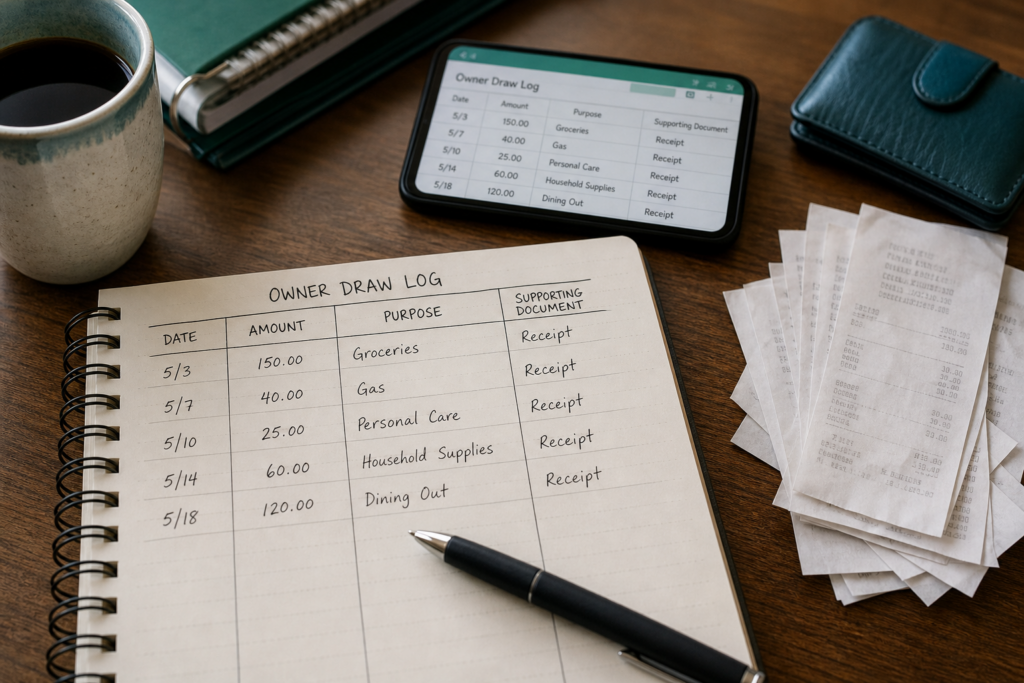
Set up a four-column owner draw log
Keep the log in a spreadsheet, bookkeeping app, or a dedicated notebook. The tool matters less than recording transactions consistently and retaining the documents behind them. The IRS says a recordkeeping system should clearly show income and expenses, while supporting documents should identify the payee, amount, proof of payment, date, and business purpose. IRS: What Kind of Records Should I Keep?
Use one row for each transfer out of the business account that is not clearly a vendor payment. Review the log weekly while your memory and source documents are still available.
- Date: when the money moved.
- Amount: the exact transfer amount.
- Type: owner draw, personal reimbursement, tax-reserve transfer, or estimated-tax payment.
- Memo and evidence: for example, “transfer to personal checking for household spending” or “federal estimated-tax payment confirmation saved.”
Use a simple example to keep the profit-and-loss report clean
Suppose a freelance designer receives $900 from clients during the week, buys $140 of design supplies, transfers $300 to a personal account for household spending, and moves $150 to a separate tax-reserve savings account. The $900 is recorded as gross business income. The $140 is reviewed as a possible business expense and matched to its receipt. The $300 owner draw and $150 reserve transfer are cash movements, not operating expenses.
This distinction matters because personal withdrawals do not measure business profit. For a sole proprietor, business profit is generally determined from business income and allowable business costs, not from how much money was moved to a personal account. Publication 334 notes that a drawing account can be used to track business income withdrawn for personal and family expenses, and it emphasizes separating mixed business and personal costs. IRS Publication 334: Tax Guide for Small Business
- Record client payments in income before deciding how much to transfer for yourself.
- Record each purchase based on what it was for, not which account paid for it.
- Do not classify groceries, rent, or other household purchases as side-hustle costs simply because they were paid from a business account.
- If a charge has both personal and business use, document the business portion separately before recording an expense.
Turn the log into an estimated-tax review
Once each month, reconcile the business checking account, update income and expense records, and total owner draws separately from business expenses. Then review year-to-date profit, other household income, withholding from a job, and prior estimated payments before deciding whether an estimated-tax calculation needs updating.
Estimated tax can cover income tax and self-employment tax. The IRS says individuals generally may need estimated payments when they expect to owe at least $1,000 after withholding and refundable credits and do not meet the applicable payment thresholds; Form 1040-ES and its worksheets are the starting point for the calculation. 2026 Form 1040-ES
A tax reserve is a cash-planning tool, not a substitute for calculating a payment. Avoid choosing a reserve percentage by copying someone else’s situation. Your income, deductions, filing status, withholding, and other taxable income can all affect the result.
- Reconcile business bank and payment-platform activity to your income records.
- Confirm that transfers to yourself are in the owner draw log rather than expense categories.
- Compare year-to-date income and allowable expenses to the prior month.
- Save estimated-tax payment confirmations with your tax records.
- Use the current Form 1040-ES worksheet or discuss the calculation with a qualified tax professional.

A 20-minute monthly checklist for side-hustle owners
A small monthly routine is often easier than reconstructing a year of activity at filing time. The IRS specifically lists bank, payment-app, card-processor, and marketplace statements, along with receipts, mileage logs, estimated-tax payments, and other business income and expense records as useful self-employment records. IRS: Gather Your Documents
Choose a recurring date, such as the first Saturday after month-end. Save documents in one folder structure by year and month so the bank activity, receipts, payment confirmations, and draw log can be reviewed together.
- Download business bank, card, processor, and marketplace statements.
- Match each deposit to a sale, invoice, payout report, or client payment record.
- Match each business expense to a receipt and a clear business-purpose note.
- Add personal transfers and tax-reserve movements to the owner draw log.
- Review uncategorized transactions before closing the month.
- Store estimated-tax confirmations separately from operating receipts.
- For Etsy or retail sellers: match gross sales, refunds, fees, and payouts before recording the bank deposit.
- For home-service or freelance work: attach the job, client, or invoice number to each material or contractor cost.
Frequently asked questions
Is an owner draw a business expense?
Generally, no. A transfer to yourself for personal spending is different from a cost of operating the business. Record it separately so it does not reduce the expense total on your profit-and-loss report.
Can I pay a business cost with my personal card?
Keep the receipt, proof of payment, date, amount, and business-purpose note. Record the business cost separately from your personal spending, then use a consistent method to show that you personally paid it. Entity structure can affect the best bookkeeping treatment, so get help if the transaction is significant or recurring.
Does a tax-reserve transfer reduce my side-hustle profit?
No. Moving cash into a separate savings account can help with planning, but it is not itself an operating expense. Keep the transfer visible in your cash records and retain documentation when an actual estimated-tax payment is made.
How often should I update the owner draw log?
Weekly is practical for active side hustles, with a full bank reconciliation and profit review each month. Timely records are usually easier to verify than a reconstruction made long after the transaction.
Will this log tell me exactly how much estimated tax to pay?
No. The log gives you cleaner income, expense, transfer, and payment records. Use those records with the current Form 1040-ES worksheet and your full tax situation, or consult a qualified tax professional for a calculation.
Sources and further reading
This article provides general educational information and is not tax, legal, accounting, or investment advice. Rules and individual circumstances can change; consult an appropriately qualified professional for advice about your situation.