
Know Which Service Calls Actually Make Money
10/19/2026

By Talia. E
A busy schedule can create a false sense of profit. A service call may be fully paid and still underperform once technician time, drive time, parts, truck use, permits, callbacks, and payment fees are considered. The practical question is not whether every call hits one universal margin target. It is whether your books show which types of calls consistently support the crew and trucks required to perform them.
Use a simple service-call closeout record to compare quoted or invoiced revenue with the costs you can identify for that visit. This is a management tool, not tax, legal, or financial advice. Keep the supporting invoice, receipt, time record, and payment evidence with the job record; the IRS says a business recordkeeping system should clearly show income and expenses, with documents supporting the entries in the books. IRS: What kind of records should I keep
Start with a consistent definition of a completed service call
Create one closeout record per dispatched ticket, even when the call results in no repair, a quoted replacement, warranty work, or a maintenance-plan visit. The record should identify the customer, service date, technician, invoice number, service type, and final status: completed, callback, quoted, canceled, warranty, or membership visit.
Make revenue visible separately from cash collected. For example, an October repair may be invoiced in October but paid in November. The Small Business Administration notes that accrual accounting records a sale when it occurs, while cash accounting records it when payment is received. Whichever bookkeeping method you use, a service-call report should consistently distinguish the invoice amount from the payment date. SBA: Manage your business
- Use a short service-type list: diagnostic only, repair, maintenance, emergency, warranty, quoted work, and callback.
- Record the original ticket number on every callback so its cost stays connected to the first visit.
- Mark maintenance-plan visits separately rather than treating them as free or invisible work.
Capture the five costs that explain most margin surprises
For each completed ticket, record direct labor, parts used, job-specific outside costs, payment fees, and a simple vehicle or truck-use measure. Do not wait for a perfect allocation system. The immediate goal is to see reliable patterns: calls that require repeated supply-house runs, repairs with frequent callbacks, or service areas that consume unusually high drive time.
For employee labor, use the hours actually connected to the call: travel between jobs, onsite work, return trips, and required wrap-up. Under the Fair Labor Standards Act, travel between job sites during the workday is generally hours worked; pay rules can be fact-specific, so use your payroll process and seek qualified help when needed. U.S. Department of Labor: FLSA Hours Worked Advisor
- Direct labor: technician and helper hours multiplied by your internal hourly labor-cost figure.
- Parts: quantity used multiplied by actual purchase cost, including identifiable freight or rush charges.
- Outside costs: permits, equipment rental, subcontractor help, disposal, or a job-specific supply-house delivery.
- Payment fees: card or financing fees tied to the invoice, when identifiable.
- Vehicle use: miles, drive-time minutes, or a fixed internal truck-use amount applied consistently.

Handle parts and truck stock without double counting
A supplier bill is not automatically the cost of the service call that week. Parts bought for truck stock may sit unused, be returned, move to another truck, or be installed on a later ticket. Record the purchase in a parts or truck-stock account, then move the cost to a service call when the technician records the item as used. This produces a more useful call-level margin report than assigning every supplier payment to the latest job.
Federal tax treatment can depend on the business’s accounting method and facts. IRS Publication 334 explains that businesses that sell or charge customers for the materials and supplies normally used in their services may need to consider cost-of-goods-sold rules, and it describes special inventory options for qualifying small business taxpayers. Align your internal job-costing workflow with the method used in your books and tax return rather than treating the service-call worksheet as a tax calculation. IRS Publication 334: Tax Guide for Small Business
- Match a parts issue to the ticket number, date, technician, item, quantity, and unit cost.
- Reverse the entry for unused parts returned to stock.
- Record supplier credits and returns against the original parts or stock record.
- Review high-value truck-stock items monthly for missing issue records or unexplained shrinkage.
Calculate a service-call contribution number before overhead
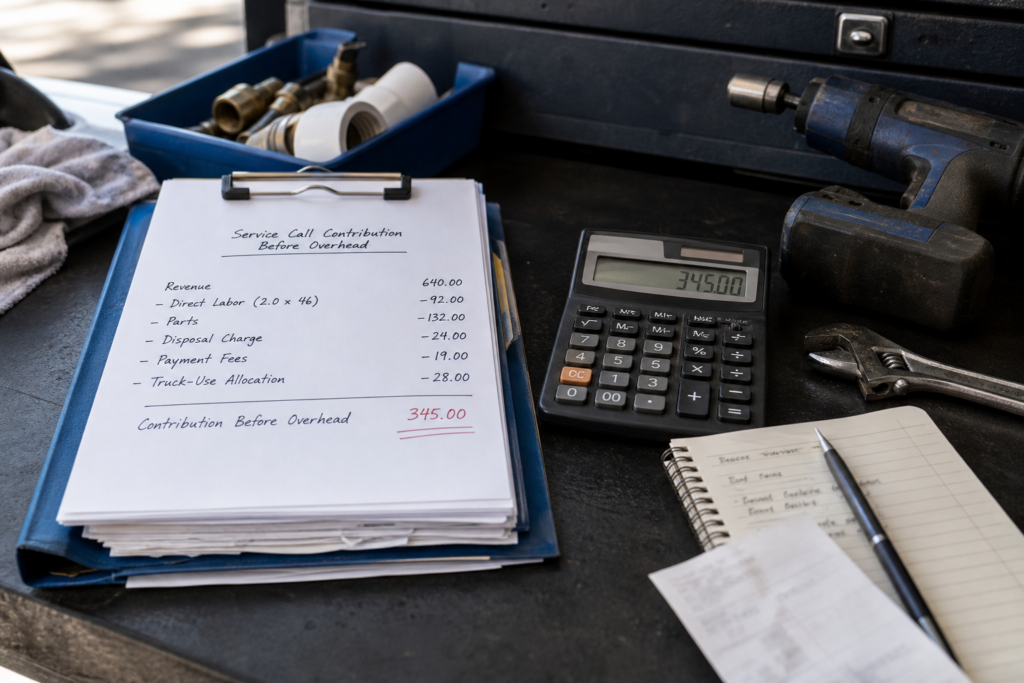
A straightforward internal calculation is: service-call revenue minus direct labor, parts used, job-specific outside costs, payment fees, and the truck-use measure. The remaining amount is the call’s contribution before shared business costs such as office payroll, insurance, dispatch software, rent, management time, and general advertising.
Example: A repair invoice is $640. The technician logged 2.0 call-related hours at an internal labor cost of $46 per hour, used $132 of parts, incurred a $24 disposal charge, had a $19 card fee, and received a $28 truck-use allocation. The call’s contribution before shared overhead is $345. Use the same formula for every call category; then compare averages by technician, service area, repair type, and maintenance-plan status rather than judging a single unusual job in isolation.
- Contribution before shared overhead = revenue − direct labor − parts used − job-specific outside costs − payment fees − truck-use measure.
- Keep discounts visible as reductions of revenue instead of hiding them in a general expense account.
- Report warranty work and callbacks with their own revenue and cost fields, even when revenue is zero.
Review the report weekly and act on the cause, not just the result
Set a short weekly review with the owner, dispatcher, or service manager. Look for exceptions rather than arguing over every ticket: unbilled parts, more than one trip, labor hours far above estimate, low-dollar calls with long drive time, canceled calls after dispatch, repeat repairs, and maintenance visits that regularly convert into unpaid extra work.
Then assign one operational correction. A low-margin pattern might call for a better truck-stock list, a dispatch-zone change, a diagnostic workflow, clearer authorization before extra work, a revised maintenance checklist, or a follow-up on supplier pricing. The point is to improve the accuracy of decisions, not to pressure technicians to recommend work a customer does not need.
- Weekly service-call margin checklist:
- Reconcile completed tickets to invoices issued and payments received.
- Check every ticket with parts against the technician’s parts-issue record.
- Link callbacks to the originating ticket and review the combined result.
- Scan for drive time, overtime, or supply-house trips that were not expected.
- Separate maintenance-plan visits from repairs and compare their labor and parts use over time.
- Investigate the largest five unfavorable variances and assign an owner and next action.
Frequently asked questions
Should a maintenance-plan visit be considered unprofitable if the invoice is zero?
Not automatically. Record the labor, parts, and truck use for the visit, then report it as a maintenance-plan category. Compare the cost of delivering the plan with the plan revenue and any properly documented follow-up work over a defined period. Avoid treating every later repair as caused by the visit; the main goal is to see the full cost to serve the plan.
What is the simplest way to include truck costs in service-call margins?
Choose one repeatable internal measure, such as miles, drive-time minutes, or a fixed amount per completed call. Apply it consistently for several months, then refine it if the report shows that certain zones or call types use far more vehicle capacity. Keep business-use vehicle records and supporting documents appropriate to your tax treatment. IRS Publication 463: Travel, Gift, and Car Expenses
Do I need to allocate office rent and insurance to every service call?
For an initial weekly report, no. First measure the direct costs that can be tied to a call. Review shared overhead separately each month, then decide whether a simple allocation will help with pricing and capacity decisions. A complicated allocation that no one maintains is less useful than a consistent direct-cost report.
How do I track a callback without making the first job look better than it was?
Give the callback its own ticket, but require the dispatcher to link it to the original ticket. Report the original repair, the callback, and the combined result. This preserves operational detail while showing the complete cost of resolving the customer’s issue.
Sources and further reading
This article provides general educational information and is not tax, legal, accounting, or investment advice. Rules and individual circumstances can change; consult an appropriately qualified professional for advice about your situation.