
Build a Seasonal Cash Calendar for Your Crew
11/22/2026

By Talia. E
A full schedule does not automatically mean enough cash in the bank. Landscaping, cleaning, repair, and other field-service businesses often pay crews, fuel trucks, and maintain equipment weeks before customers pay invoices. A seasonal cash calendar gives you one place to see the timing difference.
This is not a sales forecast or a profit-and-loss statement. It is a practical schedule of when cash is expected to arrive and when cash is expected to leave. Used weekly during busy months and monthly during slower periods, it can help you spot a gap early enough to make a deliberate decision rather than react at the last minute.
Start with cash dates, not just contract totals
List each recurring account by the period you expect to perform the work, invoice the customer, and receive payment. Those may be three different dates. A monthly maintenance agreement billed on the first of the month, for example, may produce cash later than the crew time and fuel costs needed to serve it.
Keep one line for expected collections from recurring work and a separate line for one-off cleanups, repairs, enhancement work, deposits, or progress billings. Do not treat a signed annual agreement as cash already available. Put cash into the calendar only in the period you reasonably expect it to reach the bank.
Your books should retain the invoices, deposit records, bills, receipts, and other documents behind these entries. The IRS says a business recordkeeping system should clearly show income and expenses, with supporting documents organized to back up the books and tax return. IRS Publication 583: Starting a Business and Keeping Records
- For every recurring customer, record: service period, invoice date, payment terms, expected collection date, and expected amount.
- Mark contract renewals and customer cancellations separately from ordinary monthly billing.
- Put uncertain collections in a clearly labeled “watch” column rather than counting them as dependable cash.
Build the calendar around the costs that cannot wait
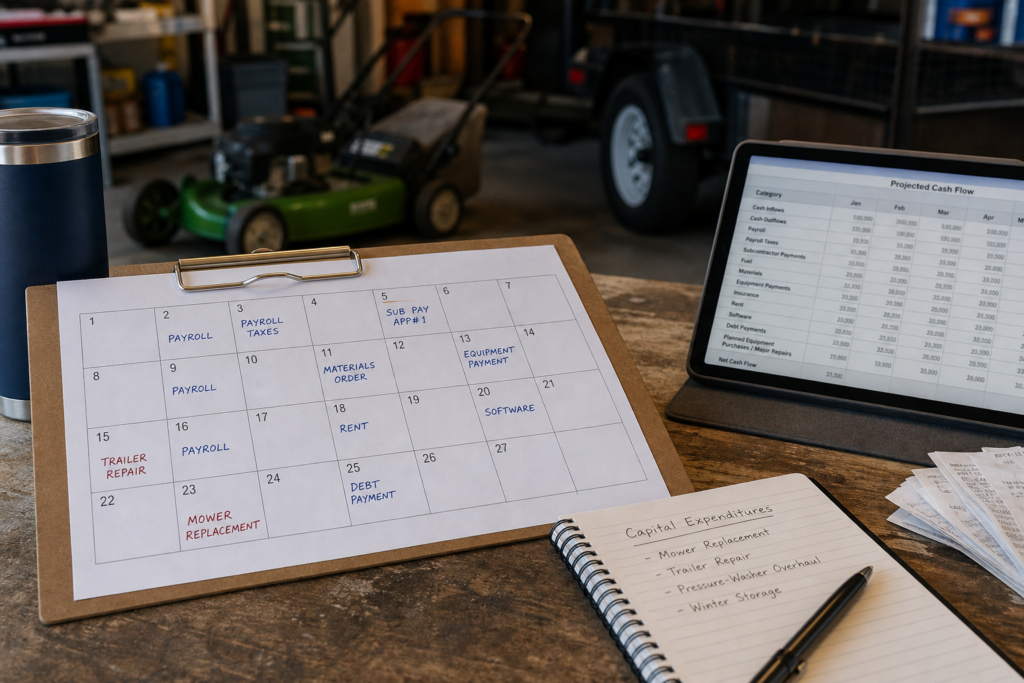
Next, enter the dates cash must leave the business. In a crew-based trade, payroll is often the least flexible item, so list each payroll date first. Then add payroll taxes, subcontractor payments, fuel, materials, equipment payments, insurance, rent, software, and debt payments.
Use a separate line for planned equipment purchases or major repairs. A mower replacement, trailer repair, pressure-washer overhaul, or winter storage bill can be real cash pressure even when it does not belong in ordinary weekly operating costs. The SBA identifies projected cash flow statements and capital-expenditure budgets as useful planning items for established businesses. SBA: Plan your business
- Payroll and related taxes
- Materials and plant purchases tied to scheduled work
- Fuel, disposal fees, repairs, and maintenance
- Equipment loans, leases, insurance, and registrations
- Recurring overhead, including rent, software, phones, and advertising
- Owner draws, recorded separately from operating costs
- Planned equipment replacements and major repairs
Use a simple rolling calculation
Set up one column for each week during the active season. For the off-season, a monthly view may be enough until work ramps up again. Start each period with the prior period’s projected ending cash, add expected collections, subtract expected cash outflows, and calculate projected ending cash.
For example, a company may have a strong April because spring-cleanup invoices are collected quickly, then face a tighter May because the second crew starts before several commercial maintenance invoices are due. The calendar makes that timing visible without confusing the May workload with May cash.
Keep the forecast separate from the accounting records. The forecast is a planning tool; the books should record what actually happened. After each bank reconciliation, replace estimates for the completed period with actual bank activity and revise future weeks from there.
- Opening cash balance
- Plus: expected customer collections
- Less: payroll, vendor payments, debt payments, and other cash outflows
- Equals: projected ending cash
- Compare projected ending cash with actual ending cash after reconciliation
Connect crew productivity to the cash calendar
A recurring route is more useful when each crew reports basic production information by property: date, crew hours, materials used, extra work approved, and whether the job was completed as scheduled. This is not about creating paperwork for its own sake. It lets you compare the labor and material commitment behind a route with the cash it is expected to produce.
Keep productivity notes distinct from payroll records and customer invoices, then link them by customer or job code. A job that routinely absorbs extra travel, setup, rework, or material use may still bring in cash on time, but the calendar and job records together show whether that cash is supporting the crew adequately.
The IRS notes that records for business property should document key details such as acquisition, cost, improvements, business use, and disposition. Maintain an equipment file for each major truck, trailer, mower, or machine rather than relying only on a card statement or loan payment history. IRS guidance on business records
- Track crew hours by recurring property or route.
- Record materials and disposal costs when they are used or purchased for the work.
- Note approved extras separately from the base recurring service.
- Maintain an equipment register with purchase documents, repairs, improvements, financing details, and disposal information.

Run a short weekly review before the next crew week starts
Choose one consistent review time, such as Friday afternoon or Monday before dispatch. Update bank cash, invoices collected, bills due, payroll, and major work scheduled for the next several weeks. The goal is not a perfect prediction. It is a current, evidence-based view of near-term cash.
If the calendar shows a shortfall, investigate the cause before changing anything: late collections, underbilled extras, an upcoming equipment repair, seasonal revenue decline, an early material purchase, or draws that exceeded the plan. Then document the decision you make, such as following up on a specific invoice, delaying a discretionary purchase, or changing the timing of a planned draw.
A useful cash calendar does not replace professional tax, legal, or financial advice. It does give your bookkeeper, accountant, lender, or advisor cleaner information to review.
- Reconcile the bank account and update opening cash.
- Mark invoices collected and bills actually paid.
- Review overdue customer balances by expected collection date.
- Confirm the next payroll and vendor-payment dates.
- Update upcoming equipment and seasonal costs.
- Compare forecasted ending cash with actual ending cash and note the reason for material differences.
Frequently asked questions
Should recurring monthly contracts be entered as income for the whole year?
For a cash calendar, enter expected cash collections in the periods you expect customers to pay, not the full annual contract value at once. Your accounting treatment may differ based on your bookkeeping and tax method, so keep the forecast separate from the books.
How far ahead should a seasonal cash calendar look?
Start with 13 weeks if cash timing is difficult to see. Add a higher-level monthly view for the remaining year so slower months, renewals, insurance payments, and planned equipment spending are visible.
Should owner draws be included in the calendar?
Yes. Include planned draws as a separate cash-outflow line. Keeping them separate from payroll, supplies, and vendor bills makes it easier to see whether operating cash is being used for the business or for owner withdrawals.
What if a customer consistently pays late?
Use the collection timing you actually experience in the forecast, not the date printed on the invoice. Keep the invoice and follow-up activity in your receivables records, then revise the expected collection date as new information becomes available.
Do I need special software to use this system?
No. A spreadsheet can work if it is updated consistently and tied to reconciled bank activity. The essential elements are clear categories, expected dates, actual results, and supporting records.
Sources and further reading
This article provides general educational information and is not tax, legal, accounting, or investment advice. Rules and individual circumstances can change; consult an appropriately qualified professional for advice about your situation.