
Reconcile POS Payouts Without Booking Net Sales
10/22/2026

By Talia. E
A payment-processor deposit is not the same thing as sales. A Shopify, Square, Toast, Stripe, or similar payout may combine customer payments, refunds, processing fees, chargebacks, and timing adjustments before the net amount reaches the bank. Recording only that net deposit as revenue can understate sales and hide the cost of refunds and card processing.
A cleaner approach is to record the activity behind each payout, temporarily hold the net amount in a payment-processor clearing account, and then match the cleared amount to the bank deposit. This gives retail, ecommerce, Etsy-adjacent, and restaurant businesses a repeatable way to close the month without treating the bank feed as the whole sales record.
Why the bank deposit should not be your sales number
Payment platforms commonly report gross card and marketplace payments before fees, credits, refunds, shipping, cash equivalents, and discounts. The IRS specifically notes that Form 1099-K gross payment amounts are not adjusted for those items, so business records should retain the reports needed to identify them separately. What to do with Form 1099-K | IRS
For a business that sells merchandise, returns and allowances reduce gross receipts to arrive at net receipts; cost of goods sold is then considered separately when determining gross profit. That is why a refund should not be buried inside a lower bank deposit or treated as a new operating expense. Publication 334: Tax Guide for Small Business | IRS
- Gross sales show what customers were charged for products, food, shipping, or services.
- Refunds and allowances show value returned or credited to customers.
- Processor fees show the cost of accepting payments.
- The net payout is the cash that arrived, after the processor combined the activity.
Set up one payment-processor clearing account
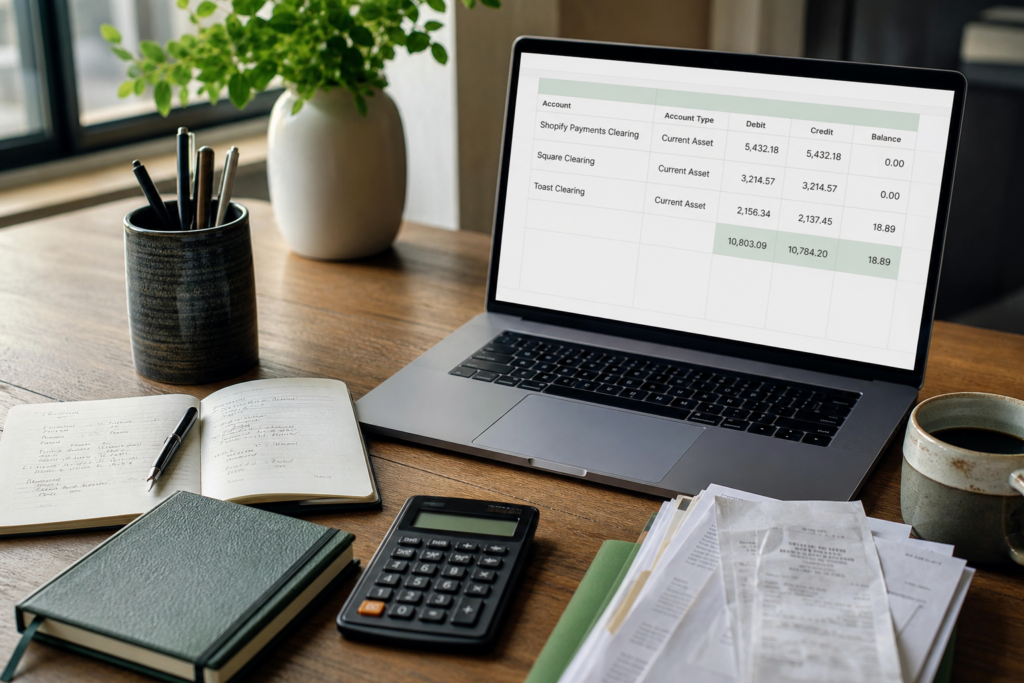
Create a separate clearing account in the books for each material processor or channel, such as “Shopify Payments Clearing,” “Square Clearing,” or “Toast Clearing.” This is not an extra bank account. It is a temporary holding account that lets the platform report and the bank deposit meet in the middle.
Use the clearing account consistently: post the components of a payout to it first, then use the net payout to clear it when the related deposit reaches the bank. A properly reconciled payout should leave that payout’s clearing balance at zero, except for documented timing items that have not yet reached the bank.
- Keep a separate clearing account when separate platforms issue separate settlement reports.
- Name each payout entry with the payout ID and payout date.
- Do not use the clearing account for unrelated transfers, owner spending, or vendor bills.
- Review any clearing balance that remains after the expected deposit date.
Use the payout report, not just the order total
For every payout, download or preserve the processor settlement report. It should identify the payout ID, gross payments, refunds, fees, adjustments, and net amount. The IRS recommends retaining documents that support gross receipts and expenses, including credit-card documentation, account statements, invoices, and other underlying records. Publication 583: Starting a Business and Keeping Records | IRS
Match the report to the specific deposit rather than trying to force every calendar-month sale to equal every calendar-month bank deposit. A payout issued near month-end may contain activity from one period and arrive in the bank during the next.
- Save the payout or settlement report as the support for the accounting entry.
- Compare the report’s net payout to the bank deposit amount and date.
- Investigate withheld reserves, disputes, chargebacks, rolling holds, and currency adjustments separately.
- Keep the source order, refund, or POS report available when an adjustment needs research.
Post a simple payout example
Suppose an online retailer’s payout report shows $2,500 of customer sales, $180 of refunds, and $95 of processing fees. The processor sends $2,225 to the bank. The bookkeeping objective is to show each component and still have the payout reconcile exactly.
One common entry structure is to debit the payment-processor clearing account for the gross customer payments and credit sales. Then debit refunds and allowances and processing-fee expense, with offsetting credits to the clearing account. The remaining clearing balance is $2,225, which is cleared when the $2,225 bank deposit is matched. Your account names and posting detail should fit your accounting method and chart of accounts.
- Gross customer payments: $2,500
- Less refunds and allowances: $180
- Less processor fees: $95
- Net amount expected in bank: $2,225
- Result: the clearing account returns to zero after the bank deposit is matched.

Add restaurant-specific checks for tips and service charges
Restaurants should separate sales, voluntary tips, service charges, and card fees rather than assuming every amount on a POS report is sales revenue. The IRS distinguishes voluntary tips from mandatory service charges: voluntary tips are not included in the employer’s gross receipts, while required service charges are income to the employer even if they are later distributed to employees. Tip recordkeeping and reporting | IRS
Build this distinction into the POS mapping before the monthly close. A mandatory large-party charge, for example, may need a different account from a voluntary guest tip. Coordinate the payroll and bookkeeping treatment with the records used by your payroll provider and tax preparer.
- Compare POS sales summaries with processor settlement reports.
- Separate voluntary tips from required service charges in the account mapping.
- Review refunds, voids, discounts, gift cards, and delivery-platform adjustments.
- Tie cash sales to daily cash counts and documented deposits, separately from card payouts.
Run this payout checklist each week or month
The IRS advises businesses to reconcile checking accounts monthly so the statement, books, and account records agree. A frequent payout review makes missing deposits and unexplained adjustments easier to find before they accumulate. Publication 583: Starting a Business and Keeping Records | IRS
For low transaction volume, this process may be practical for each payout. For a higher-volume store or restaurant, complete it at least during the monthly close, using a consistent report export and exception list.
- Download the payout report and identify its payout ID.
- Confirm gross payments agree to the platform or POS sales detail.
- Post refunds, fees, disputes, holds, and adjustments separately.
- Calculate the expected net payout.
- Match the net payout to the bank deposit.
- Confirm the payout-level clearing balance is zero or explain the remaining amount.
- File the settlement report and supporting export with that month’s close records.
- Escalate unexplained differences instead of posting them to a generic expense account.
Frequently asked questions
Can I record the net Shopify or POS deposit as sales?
You can match the net deposit to the bank, but treating it as the full sales amount can hide gross customer payments, refunds, and processor fees. A clearing-account workflow preserves those components while still reconciling the bank deposit.
Are processor fees included in a Form 1099-K amount?
The IRS explains that the gross payment amount reported on Form 1099-K is not adjusted for fees, credits, refunds, shipping, cash equivalents, or discounts. Compare the form with processor reports and your books rather than expecting it to equal net bank deposits. What to do with Form 1099-K | IRS
What if a refund happens after the original sale payout?
Record the refund when the platform reports it and let it reduce the clearing account in the payout where it appears. Link it to the original order when possible, but do not force it into the earlier payout if the processor deducted it later.
Why does my processor clearing account have a balance at month-end?
Common reasons include payouts still in transit, processor reserves, chargebacks, refunds deducted from later payouts, or an entry posted twice. Compare the balance to open payout reports and identify each item by payout ID before closing the month.
Do restaurant tips belong in sales revenue?
Voluntary tips are not included in the employer’s gross receipts according to the IRS, while mandatory service charges are employer income. Keep them distinct in POS and payroll records. Tip recordkeeping and reporting | IRS
Sources and further reading
This article provides general educational information and is not tax, legal, accounting, or investment advice. Rules and individual circumstances can change; consult an appropriately qualified professional for advice about your situation.