
Plumbing Deposit Tracker for Materials and Cash Flow
10/13/2026

By Talia. E
A plumbing job can look profitable on an estimate while still putting pressure on the bank account. That usually happens when a material order is paid before the customer deposit arrives, a completed service call is not invoiced promptly, or a deposit is counted again when the final invoice is paid.
A simple job cash tracker will not replace your accounting system, but it can give the owner or office manager a daily view of what each active job has brought in, what has gone out for materials, and what must be collected next. This article is educational and is not tax, legal, or accounting advice.
Use one question to guide every active job
For each active job, compare customer cash collected with committed material purchases and the next payment due. Keeping those amounts together makes the collection task easier to identify before more cash leaves the business.
That is different from asking whether the estimate has a healthy margin. Margin is a profitability measure; cash timing is a collection-and-payment measure. You need both views, but they answer different questions.
- Margin view: quoted price minus direct job costs, such as materials and assigned labor.
- Cash view: customer money received minus material cash paid and other near-term job cash needs.
- Collection view: the remaining amount to invoice or collect after work is completed.
Set up a five-column plumbing deposit tracker
Create one row for every quoted repair, replacement, or larger installation that has a customer commitment. A spreadsheet, job-management export, or accounting-system report can work if it shows the same core fields. Use the job number consistently on the estimate, supplier receipt, customer payment, and final invoice.
Keep source documents with the job record. The IRS says a business recordkeeping system must clearly show income and expenses, and supporting documents can include invoices, receipts, sales slips, paid bills, deposit information, and account statements. IRS: What kind of records should I keep
- Job and customer: job number, customer name, job type, scheduled date.
- Quoted amount: approved estimate plus any documented approved change orders.
- Cash received: deposit date and amount, then later payment dates and amounts.
- Committed and paid materials: supplier, receipt or purchase-order number, amount, and whether paid or still due.
- Next action: collect deposit, order materials, invoice balance, follow up, or close the job.

Separate a deposit from the final job payment
For management reporting, record a customer deposit as money received on that specific job, then apply it against the final approved invoice when the work is billed. This prevents the common error of showing both the deposit and the full invoice as separate revenue in an internal job report.
Example: A water-heater replacement is quoted at $2,400. The customer pays a $900 deposit. Materials cost $780 and are paid at pickup. Your tracker shows $900 received, $780 material cash paid, $120 of cash remaining from the deposit, and $1,500 still to invoice at completion. When the customer pays the balance, total customer cash received becomes $2,400, not $3,300.
Your internal job tracker does not decide tax reporting by itself. Accounting-method rules matter: the IRS states that cash-method businesses generally include income actually or constructively received during the tax year, while accrual-method rules and advance-payment rules can differ. Confirm how deposits should be handled in your books and tax return with the professional preparing them. IRS Publication 538: Accounting Periods and Methods IRS Publication 334: Tax Guide for Small Business
- Do not label a deposit as a second sale when you issue the final invoice.
- Keep a clear reference from the payment processor or bank deposit to the customer and job number.
- If one bank deposit combines several card payments, retain the processor detail that identifies each customer payment.
- Record refunds, discounts, and approved change orders separately rather than silently changing the original estimate.
Make materials visible before they become a bank-balance problem
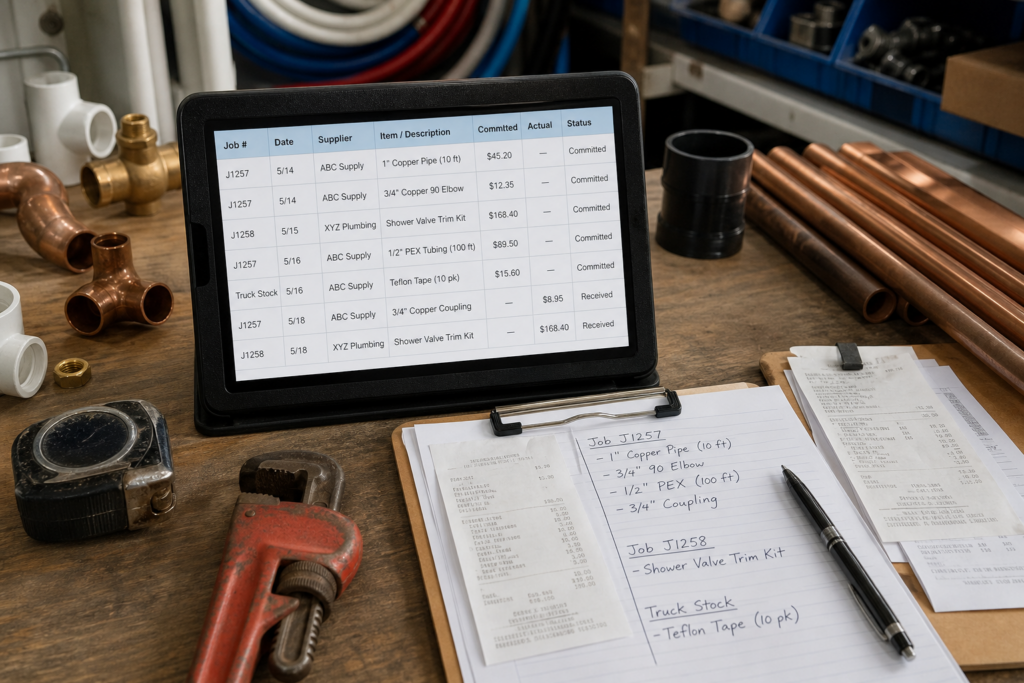
Add material commitments as soon as a part is ordered or a supplier quote is accepted, even if the supplier has not charged the card yet. This gives you a forward-looking cash view instead of waiting for the card or supplier statement to arrive. When the receipt arrives, attach it to the job and replace the estimate with the actual amount.
For jobs with several supply-house runs, use the same job number on every receipt. If a purchase contains parts for more than one job or restock items for the truck, split the receipt in the tracker while preserving the original receipt image. The IRS notes that purchase support should identify the payee, amount, proof of payment, date incurred, and a description of what was purchased. IRS: What kind of records should I keep
- Committed materials: approved but not yet paid or picked up.
- Job materials paid: parts bought specifically for the customer job.
- Truck stock: common fittings and supplies replenished for future work, reviewed separately from a single job's materials.
- Non-job overhead: insurance, software, phones, and other costs that should not be mistaken for job-specific materials.
Run a 15-minute cash review before dispatch
Before the day begins, filter the tracker to jobs scheduled this week, jobs with materials to buy, completed jobs with an unpaid balance, and invoices past their stated due date. Assign one next action to each row. The goal is not a complicated forecast; it is making sure a technician is not dispatched to a material-heavy job before the collection plan is visible.
Also reconcile the tracker to bank and card activity each week. Match each recorded customer payment and material purchase to its supporting documents, and investigate differences before using the tracker to plan the next purchase.
- Before ordering: verify the approved estimate, customer deposit status, and expected supplier payment date.
- At dispatch: confirm the job number is on the work order and material receipt process is clear.
- At completion: enter actual materials, send the final invoice or take payment, and apply the deposit once.
- Weekly: compare tracker cash received and cash paid to bank, card, processor, and supplier records.
- Monthly: review jobs with a large gap between quoted margin and collected cash, then investigate missing invoices, unrecorded materials, credits, or owner-paid purchases.
Frequently asked questions
Should a customer deposit be counted twice when the final invoice is paid?
No. For internal job tracking, show the deposit as part of total cash collected for the job and apply it against the final invoice balance. Keep the original payment record so the audit trail remains clear.
What if a supplier receipt covers two plumbing jobs?
Keep the full receipt, then allocate the relevant line items to each job number in the tracker. Note the split clearly so the combined allocations equal the receipt total.
Should truck-stock purchases go directly to one job?
Usually not if the items are intended for general future use. Track truck-stock replenishment separately from materials purchased specifically for a customer job, then use a consistent internal method to account for stock used on jobs.
Does a deposit always have the same tax treatment as deferred revenue?
Not necessarily. Internal job reporting and tax reporting can use different timing rules depending on the accounting method and facts. The IRS explains that cash-method income is generally included when received, while special rules can apply to advance payments and accrual-method taxpayers. Review the treatment with your tax professional. IRS Publication 538: Accounting Periods and Methods
How often should a small plumbing shop update this tracker?
Update it whenever a deposit is received, material is committed or purchased, a final invoice is sent, or payment is collected. A short daily review is usually more useful than trying to rebuild the information at month-end.
Sources and further reading
This article provides general educational information and is not tax, legal, accounting, or investment advice. Rules and individual circumstances can change; consult an appropriately qualified professional for advice about your situation.