
Match Split Payments to One Business Invoice
11/12/2026

By Talia. E
When a vendor invoice is paid with a deposit, a later card charge, and perhaps a credit or refund, the bank feed alone does not explain the full purchase. A cleaner approach is to maintain one purchase file that connects the invoice, every payment, and a brief note about what the business received. The IRS says a recordkeeping system may be tailored to the business if it clearly shows income and expenses, and that supporting documents should be kept in an orderly way. IRS: What kind of records should I keep?
Start with one invoice file, not separate payment scraps
Create a single digital record for the vendor bill or purchase. Put the original invoice or final receipt at the center, then attach the payment evidence as it occurs. This avoids treating a deposit and final payment as unrelated expenses when they are really parts of one purchase.
For purchases and other business expenses, the IRS says supporting records should identify the payee, amount paid, proof of payment, date incurred, and a description showing what was bought or received for the business. It also notes that a combination of documents may be needed to substantiate all parts of an expense. IRS: What kind of records should I keep?
- Invoice or paid receipt: vendor, invoice number, date, total, and what was purchased.
- Payment evidence: card record, ACH confirmation, cleared-check image, or bank transaction for each installment.
- Purpose note: a short explanation such as “replacement compressor for Job 417” or “annual scheduling software for field team.”
- Bookkeeping references: expense category plus any job, client, vehicle, inventory, or asset reference.
- Status: unpaid, partially paid, paid, credited, refunded, or disputed.
Use a payment schedule that makes the total visible
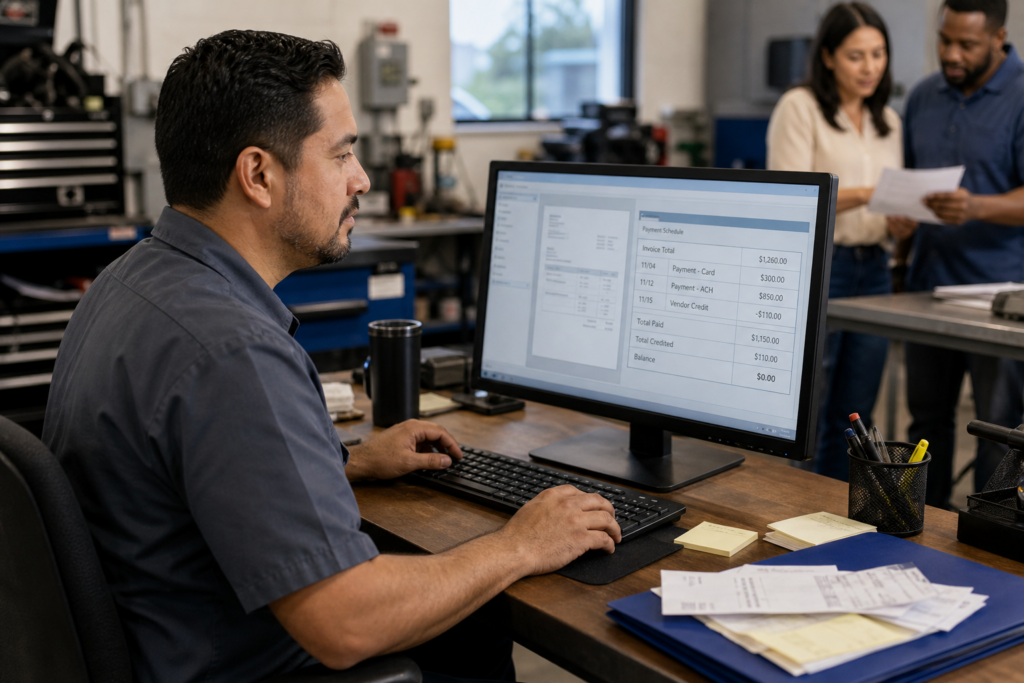
Add a small payment schedule to the invoice file or the bill record in your accounting system. The schedule should show the invoice total, each payment date and amount, any vendor credit or refund, and the remaining balance. It gives the reviewer one place to see why several bank lines belong together.
Example: A contractor receives a $1,260 materials invoice. They pay a $300 card deposit on November 4, an $850 ACH payment on November 12, and receive a $110 vendor credit for returned fittings on November 15. The file should show $1,260 invoiced, $1,150 paid, $110 credited, and a zero balance. The payment proof supports the movement of money; the invoice and return documentation explain what the amounts relate to.
- Use the vendor’s invoice number as the common reference whenever it is available.
- If the bank descriptor is abbreviated, match using a combination of vendor name, date, amount, card ending, order number, or payment reference.
- Keep the original invoice total visible even after an adjustment or credit.
- Do not create a second expense merely because a receipt-upload tool and the bank feed both captured the same purchase; review whether they represent the same underlying transaction before posting.
- If one payment covers several invoices, retain the payment confirmation once and list the invoice amounts it settles.
Capture the business purpose while the purchase is fresh
A category alone may be too broad to explain a transaction later. “Repairs and maintenance” is useful for grouping costs, but a note such as “oil change for service van 3” makes the record easier to review. Attach the business-purpose note to the invoice file when the document itself does not make the purpose clear.
Keep the note factual and brief. State what the business bought or received and, where useful, the related job, client, asset, location, or period of service. Avoid trying to reconstruct vague details months later from memory.
For assets such as machinery, furniture, or vehicles, keep acquisition and use records more carefully. The IRS says asset records are needed to verify depreciation information and the gain or loss when property is sold. IRS: What kind of records should I keep?
- HVAC, plumbing, and electrical: add job number, service-call number, or truck number.
- Remodeling and construction: add project, phase, change-order, and materials-return reference.
- Retail and ecommerce: add purchase order, inventory SKU or receiving record, and quantity.
- Consulting and agencies: add client, project, retainer period, or internal team purpose.
- Auto repair and transportation: add repair order, vehicle or equipment number, and relevant mileage or service reference.
- Property services: add property, unit, and work-order reference; flag costs that may need repair-versus-improvement review.
Use an exception log for missing or confusing documents
A missing receipt should not disappear into an uncategorized pile. Put the transaction in a short exception log, gather the evidence that is available, and record the follow-up needed. The aim is to make uncertainty visible rather than to guess.
For a cash payment where a receipt cannot be obtained, IRS Publication 583 says to make an adequate explanation in the records at the time of payment. The publication also cautions that proof of payment by itself does not establish entitlement to a deduction; other records may be needed to show that the cost was incurred. IRS Publication 583: Starting a Business and Keeping Records
- Transaction date and amount.
- Vendor name exactly as it appears in the bank or card activity.
- Available support, such as an email confirmation, vendor portal history, order record, or payment confirmation.
- Short business-purpose note and the related job, client, asset, or inventory reference.
- Owner or employee responsible for follow-up.
- Status: waiting for document, matched, explained, duplicate review, personal charge review, or vendor-credit review.

Run a short weekly matching routine
Set aside a recurring weekly time to bring in new invoices and receipts, match them to new bank and card activity, and update open balances. A weekly habit reduces the number of unidentified entries that reach month-end and gives the person who made the purchase a better chance of recalling its purpose.
Electronic storage is workable when the records remain organized and retrievable. The IRS says electronic accounting systems are subject to the same basic recordkeeping principles as paper records. IRS: What kind of records should I keep?
This article is general educational information, not tax, legal, accounting, or investment advice. Recordkeeping needs can differ by business and transaction, so seek appropriately qualified guidance for your situation.
- Collect emailed invoices, downloaded confirmations, and scans of paper receipts.
- Open each new bank or card line and link it to an invoice file, receipt, or exception-log entry.
- Update the payment schedule for invoices that are only partly paid.
- Add the business-purpose note before the details become hard to recall.
- At month-end, reconcile accounts and resolve or clearly document remaining exceptions.
Frequently asked questions
Is a credit-card statement enough to support a business purchase?
A card statement is useful proof that a payment occurred, but it may not show everything about what was purchased or why it was a business cost. The IRS lists statements, card receipts, invoices, and other payment records as possible supporting documents, and says more than one document may be needed to substantiate all elements of an expense. IRS: What kind of records should I keep?
What if one card payment includes several vendor receipts?
Keep the individual receipts with the single payment record and add an allocation note showing how the total breaks down by category, job, inventory item, or other tracking reference. Check that the receipt total agrees to the payment after allowing for sales tax, shipping, discounts, tips, or credits.
Can I scan paper receipts and keep digital copies?
The IRS permits electronic accounting or recordkeeping systems, but says the same basic principles that apply to paper books and records also apply to electronic records. Store scans so they remain readable, organized, and easy to retrieve with the related transaction. IRS: What kind of records should I keep?
What should I do when I paid a vendor but cannot find the receipt?
Look first for available support such as the vendor invoice, order confirmation, account history, email, or payment record. Add the item to an exception log and document its business purpose based on the information available. For cash payments with no receipt, Publication 583 specifically says to make an adequate explanation in the records at the time of payment. IRS Publication 583: Starting a Business and Keeping Records
How long should I keep purchase files?
Keep records for as long as they may be needed to administer federal tax rules. The required period depends on the circumstances, and records for property should be kept long enough to support depreciation and a later gain-or-loss calculation when the property is disposed of. IRS: What kind of records should I keep?
Sources and further reading
This article provides general educational information and is not tax, legal, accounting, or investment advice. Rules and individual circumstances can change; consult an appropriately qualified professional for advice about your situation.